
Faculty Spotlight: Dr. Gyula Katona Receives Prestigious State Honor
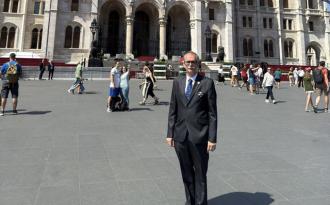
Dr. Gyula Katona, Doctor of the Hungarian Academy of Sciences and Professor at the Budapest University of Technology and Economics and at AIT, has received the Officer’s Cross of the Hungarian Order of Merit (Civil Division), one of Hungary’s prestigious state honors.
The award recognizes his decades-long scientific career, his internationally outstanding research in the field of hypergraphs, and his significant contribution to the mathematical education of future generations of engineers and computer scientists.
At AIT, Dr. Katona is a highly respected instructor of Theory of Computing, where our students have the opportunity to learn from one of Hungary’s most distinguished mathematicians.
We are incredibly proud of his achievement and grateful to have him as part of the AIT academic community.
Congratulations, Professor Katona, on this remarkable and well-deserved recognition!
New Program Launch: Arts, Film and Culture (AFC)
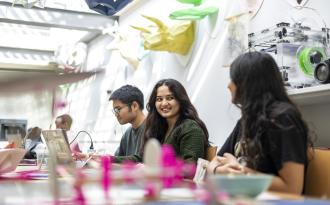
Designed for students seeking an immersive study abroad experience in the creative arts, the AFC Program combines hands-on learning with the rich cultural life of Budapest. Students can choose from courses in film, photography, visual arts, music, writing, and cultural studies while exploring one of Europe’s most inspiring cities.
The AFC Program expands AIT’s academic offerings and creates exciting new opportunities for students to learn, create, and connect across disciplines. To encourage collaboration between the programs, Computer Science students may take up to 4 credits of AFC courses, and AFC students may likewise enroll in selected Computer Science courses for up to 4 credits.
Learn more about the AFC Program at afc.ait-budapest.com
New Course: Applied AI - Practical Development with Generative and Multimodal AI
Artificial Intelligence is completely reshaping how digital products are designed and built. AIT’s new Applied AI course offers a unique opportunity to explore this technology and look under the hood of modern Generative and Multimodal AI systems. The course introduces the latest text, image, and audio technologies while building from foundational concepts to immediately applicable, cutting-edge skills.
Check out the details: https://cs.ait-budapest.com/syllabuses/applied-ai

Faculty Spotlight: Welcoming Luca Szegletes to the Deep Learning Course
Deep Learning is arguably the "hottest" and most transformative field in technology today, and we are excited to have such an exceptional instructor to guide our students. Beyond her impressive credentials, Luca is a fantastic personality who brings a special vibe and energy to the classroom, making even the most complex neural networks feel accessible and engaging.
About Luca Szegletes
Luca brings a wealth of international research and academic expertise to AIT. She is an assistant professor at the Budapest University of Technology and Economics (BME) and holds a Ph.D. in deep learning and advanced signal processing. Her career includes prestigious research positions as a visiting scholar at Stanford University, EPFL (Switzerland), and Araya (Japan).
She has been recognized with numerous honors, including a Fulbright scholarship, a JSPS fellowship, and Google’s Anita Borg award. Her primary research focus is on the cutting edge of the field: geometric deep learning and generative models.
We are incredibly proud to have an instructor of Luca’s caliber and charisma helping our students master the algorithms shaping the future.
Check out the full course details here: Deep Learning Syllabus
Check out Luca’s bio here: AIT Faculty Members
Welcome to the AIT team, Luca!
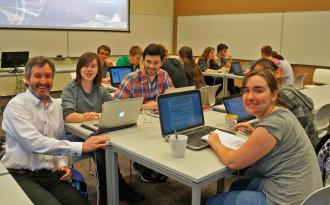
Outstanding Results in Research Abroad
Since its launch, nine dedicated students have already taken part in the Research Abroad program, and they have begun to achieve impressive research results. We are incredibly proud of all our participants, whose curiosity, and hard work demonstrate the strength of the program and the talent of our students. Their early successes show that meaningful research impact is possible even at the student level, when strong mentorship and real-world research environments come together.
Student Research Highlights
Andrew Henin (Swarthmore College)
Andrew’s research shows that database schema design has a decisive impact on the accuracy and efficiency of LLM-generated SQL queries. His work provides practical guidance for improving real-world text-to-SQL systems and was published at AACS 2025 in the paper “Evaluating Large Language Models for Text-to-SQL Tasks: Comparing First Normal Form and Star Schema.” (Supervisor: Péter Ekler)
Oliver Ramirez (Colorado College)
Oliver uncovered a clear, quantitative relationship between traditional code quality metrics and the success of AI agents in fixing real software issues. His results identify the maintainability index as the strongest predictor of successful AI-generated patches, offering valuable insights for building AI-ready software systems. The work was presented at CogInfoCom 2025 in “Exploring the Relationship Between Code Metrics and the Ability of Large Language Models to Solve Code Issues.” (Supervisor: Péter Ekler)
Mark Davletov (Wabash College)
Mark’s research demonstrates how integrating large language models into Business Intelligence environments can significantly improve query accessibility, reporting efficiency, and user interaction. His work highlights the real-world potential of conversational, AI-assisted analytics and was presented at AACS 2025 in “Evaluation of LLM Usage in the Context of BI Systems.” (Supervisor: Péter Ekler)
We look forward to seeing how future Research Abroad students will build on these achievements and continue to contribute to impactful, real-world research.
New Course: Computational Neuroscience – Algorithms in the Brain
This course explores a fascinating synergy: while AI has learned a tremendous amount from the human and animal brain, the reverse is also true—the rapid evolution of AI is now providing neuroscientists with vital new insights and tools to understand biological intelligence.
Why Take This Course?
Led by brilliant faculty members Balazs B. Ujfalussy and Mihaly Banyai, the aim is to use ideas and algorithms from Machine Learning and Artificial Intelligence to decode how cognition actually works. By focusing on real-world challenges like decision-making, navigation, and reinforcement learning, students will:
- Bridge the Gap: Directly look for the signatures of algorithmic solutions in behavioral and neuronal data.
- Gain Hands-on Experience: Develop your own models and work with actual neuronal datasets.
- Think Critically: Learn to assess published results across both the neuroscience and AI fields.
- Solve Complex Problems: Apply efficient algorithms to understand the most sophisticated computer ever made—the brain.
Check the course’s detailed syllabus here.
A Competitive Edge for Your Career
Mastering this intersection of biological and artificial intelligence is one of the most exciting and sought-after skill sets today, providing a significant advantage when applying for high-level internships or jobs in Machine Learning, Data Science, and Biotech.